

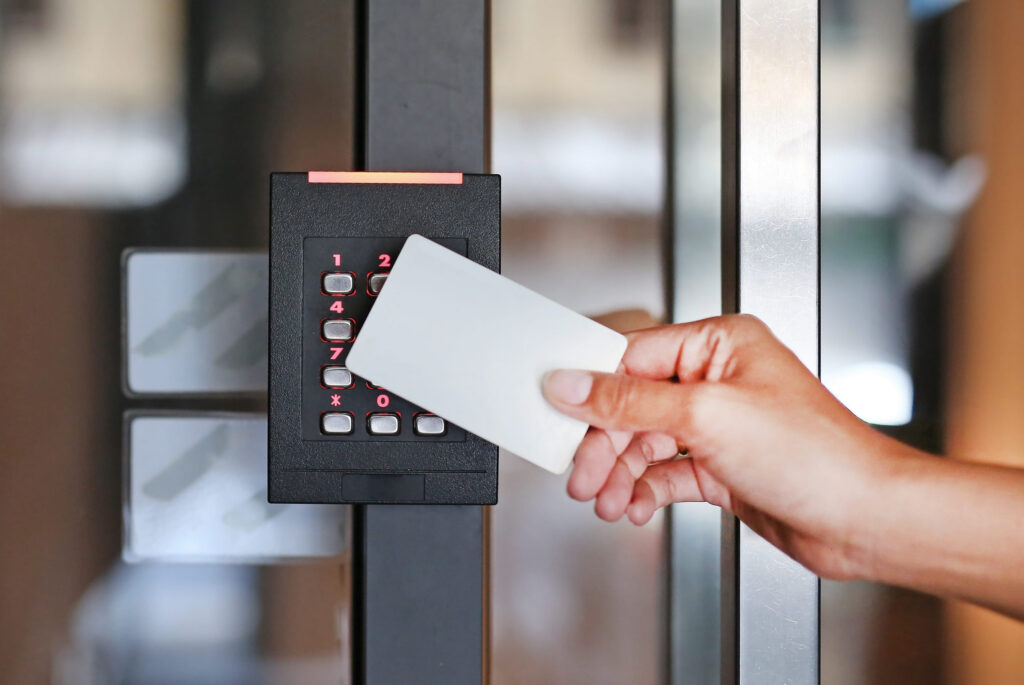
If you’re asking whether you still need a separate access control vendor, the short answer is probably not, at least not for much longer. Yes, in many businesses it already has. Access control, security cameras, and alarms now run on the same cloud systems and network gear that IT departments already manage. Because of this, IT teams are getting more say over security purchases. This shift is changing who businesses hire to handle their security, and it is happening faster than most people realize.
Key Takeaways
-
-
- IT teams are now involved in physical security buying decisions more often than physical security departments are, according to a 2026 Genetec survey.
- Security budgets are split fairly evenly today between security leadership, IT, and operations, and almost 80 percent of organizations increased physical security spending in the past year.
- Cameras, door locks, and alarms increasingly run on the same cloud and network systems as everything else IT manages, which is erasing the need for a separate specialty security vendor.
- Merging physical security with IT is mostly working, but it still creates real confusion over roles and reporting lines if it is not planned carefully.
- Businesses should ask their current IT or network provider whether they already offer security services before hiring a separate vendor.
-
What Is Security Convergence?
Security convergence is the merging of physical security (cameras, door locks, alarms) with IT and network systems. In the past, these were two separate worlds. A business would hire one vendor for its alarm system and a completely different vendor for its computer network. Today, both systems often run on the same cloud platform and the same network cables. That overlap is what people mean when they talk about security convergence.
Why Is IT Taking Over Security Purchases?
IT departments are now involved in physical security buying decisions more often than physical security departments themselves. A 2026 survey of physical security professionals by Genetec, a major security software company, found that IT was involved in these decisions 54 percent of the time, compared to 48 percent for physical security teams.
The reason is simple. Security equipment used to be a closed, separate system. You had a phone line for the alarm, a separate panel to control it, and a separate box to record camera footage. None of it talked to your computer network. This meant you needed a specialist who understood that specific hardware, and nobody else could touch it.
That is no longer true. Cameras and door locks now connect to the cloud the same way a laptop or a phone does. The special knowledge that used to justify hiring a separate security vendor is fading, because it is now the same skill set that any good IT or network provider already has.
Who Owns the Security Budget Today?
Budget ownership is already split, and IT holds a bigger piece of it than most people expect. A March 2026 survey by EY, based on responses from 250 executives and board members, found the following breakdown for who controls physical security spending:
| Who Owns the Budget | Share of Organizations |
| Chief Security Officer | 29 percent |
| IT / Chief Information Security Officer | 27 percent |
| Operations / COO | 18 percent |
| Shared or combined ownership | 18 percent |
This is nearly an even split between traditional security leadership and IT. It also is not a shrinking budget fight. The same survey found that almost 80 percent of organizations increased their physical security spending in the past year. More money is going into this space, which raises the stakes over who gets to sell into it.
What This Looks Like in Real Client Conversations
This shift is not just something in a report. It shows up in day-to-day conversations with clients. A few examples:
-
-
- A camera platform is building in access control. One video surveillance partner is adding a feature that lets a staff member remotely unlock a door straight from the camera app, a job that used to require a completely separate access control system.
- Construction teams are asking to cut vendors, not add them. On more than one project, a client’s own construction manager has asked to consolidate to one vendor for cameras, cabling, and access control instead of bringing in a specialty security company.
- Talent is moving too. A security integrator that has expanded into broader network and IT-based systems recently hired an employee away from a traditional, standalone alarm company. That kind of move shows where the job market itself is heading: skilled people are leaving single-purpose alarm companies for firms that handle the fuller, networked version of security work.
-
Is This Convergence Actually Working?

Mostly yes, but it is not painless. A widely cited ASIS International survey of over 1,000 security and IT leaders found that while 46 percent said combining physical and cyber security strengthened their overall security, and another 30 percent said it strengthened it a lot, there were real growing pains along the way. About 29 percent reported confusion over who was responsible for what, and 25 percent reported confusion over reporting lines and communication.
In other words, the shift is real and mostly positive, but it takes work to get right. Businesses that try to merge these functions overnight, without a plan for who reports to whom, and where decisions are made, run into the same friction that shows up in these surveys.
What This Means If You’re Choosing a Vendor
If your business is deciding how to handle security and IT going forward, a few questions are worth asking before you sign a new contract:
-
-
- Does your current IT or network provider already offer camera and access control services? If they do, adding a second, separate security vendor may no longer be necessary. World Link’s security systems services cover this kind of consolidated approach, from cabling and camera installation to project management and ongoing maintenance.
- Is the vendor certified for the specific hardware you already use? Some access control platforms still require formal reseller agreements or training, so not every provider can support every system yet.
- Who will you call when something breaks? Fewer vendors usually means fewer handoffs and faster fixes when there is a problem.
-
Vendor consolidation used to be a compromise. Increasingly, it is simply the smarter option.
Frequently Asked Questions
Do I need a separate access control vendor anymore? Not necessarily. Many IT and network providers, including Worldlink, can now handle some access control work directly, since the hardware runs on the same cloud and network systems they already manage. This capability is still expanding across the industry, so it is worth checking what your current provider already covers before adding a separate specialist.
Is a traditional alarm company still a good option for commercial security? It depends on the building and the industry. Traditional alarm-style providers still work well for simple, standalone setups, but many businesses are moving toward providers who can combine security with their broader network and IT support.
What is the difference between traditional and cloud-based access control? Traditional access control uses closed, on-site hardware that only a specialist can manage. Cloud-based access control runs through the internet, so it can be managed, updated, and monitored remotely, often by the same team that manages a company’s regular network.
Why is my IT department suddenly involved in security camera decisions? Because security cameras and access control systems now connect to the same network and cloud tools that IT already oversees. As a result, IT teams are naturally being pulled into decisions that used to belong only to a dedicated security department.
Ready to Simplify Your Security Setup?
If you are juggling separate vendors for your network, your cameras, and your access control, it may be time to see how much of that can live under one roof. Worldlink works with businesses to bring these systems together in a way that fits their existing setup, without forcing a rip-and-replace approach. Reach out to our team to talk through what your current setup looks like and where there is room to simplify it or where you’d like to go in the future.