

AI-native retail is not just for large operators. Here is what the path looks like for mid-market and regional chains.
Overview
Most published examples of AI-native retail come from large operators. Walmart, Amazon, and Kroger moved first and their case studies dominate the conversation. But the technology is no longer out of reach for mid-market and regional chains. The economics have shifted. What has not changed is the need for a sound operating model. This article focuses on what that model looks like for a retailer running 40 to 150 stores, where the obstacles are, and what needs to be in place before a pilot begins.
Key takeaways
-
-
- The technology works outside a Walmart context. The economics now support a credible business case at mid-market scale.
- The bigger obstacle is organizational readiness, not cost.
- A shelf-edge deployment has four operating layers. Most retailers plan for two and find the others after the pilot.
- Remote monitoring and SLA accountability belong to the MSP or technology vendor. Physical field execution is a separate layer that has to be planned.
- The integration layer is the most commonly missing piece. Someone has to connect the remote and physical sides and own the escalation path between them.
- A pilot that only tests the technology is not ready to scale. It has to test the operating model.
-
When AI-native retail comes up in a mid-market setting, a familiar moment tends to happen. The technology looks right. The vendor demos are compelling. Someone pulls up a Walmart case study. Then a quieter voice in the room says: “But that’s Walmart.”
That instinct is accurate. What Walmart built required capital depth, mature data systems, and technical staff at a scale most regional operators will never have.
But the answer is not to wait. The economics have shifted enough to support a real business case at mid-market scale. The answer is to build a different operating model. One designed for the organization that is actually deploying it.
What is different about a mid-market deployment
Mid-market retailers have one structural characteristic that cuts both ways. The distance between a technology decision and its real-world consequences is short. The executive who approves the budget often hears directly when something breaks in store 34. The IT director who selected the platform answers to a CFO who can see the margin impact.
That proximity is an advantage when accountability is clear and problems get fixed fast. It becomes a liability when the operating model has not been fully planned, because problems surface faster and more visibly than they would in a larger organization.
Geographic concentration also matters. A regional chain with 60 stores in a two- or three-state area has better field service economics than a national operator spread across 47 states. Shorter drive times and denser technician coverage mean faster repairs. That structural advantage supports a stronger SLA. But a 60-store chain spread across six states faces economics closer to a national operator. One of the first honest questions a mid-market retailer should answer is whether the store footprint is dense enough to support the physical layer at a cost the business case can carry.
The economics: what has changed
Hardware costs have come down as the market has grown. SaaS management platforms have brought per-store software licensing into a range mid-market teams can model. Outcome-based and leasing contracts have emerged for operators who cannot absorb large upfront capital costs.
At deployments above 10,000 labels, ESL systems reach cost parity with paper-based pricing when labor, printing, and pricing error costs are fully counted. A 60-store chain with a moderate SKU count can cross that threshold. The math works. But only if the business case includes the run cost as a named line item. Business cases that underestimate the run side tend to fail in year two, not because the technology underperformed, but because ongoing costs were not priced honestly from the start.
The operating model: four layers, not three
A shelf-edge deployment has four distinct layers. Most retailers plan for two and discover the others after the pilot.
The remote layer: technology vendor or MSP. This platform monitors device health, manages firmware updates, tracks configuration drift, and holds the SLA contractually. It owns the dashboard, the alerts, and the uptime commitment on paper.
What this layer cannot do is walk to aisle 12.
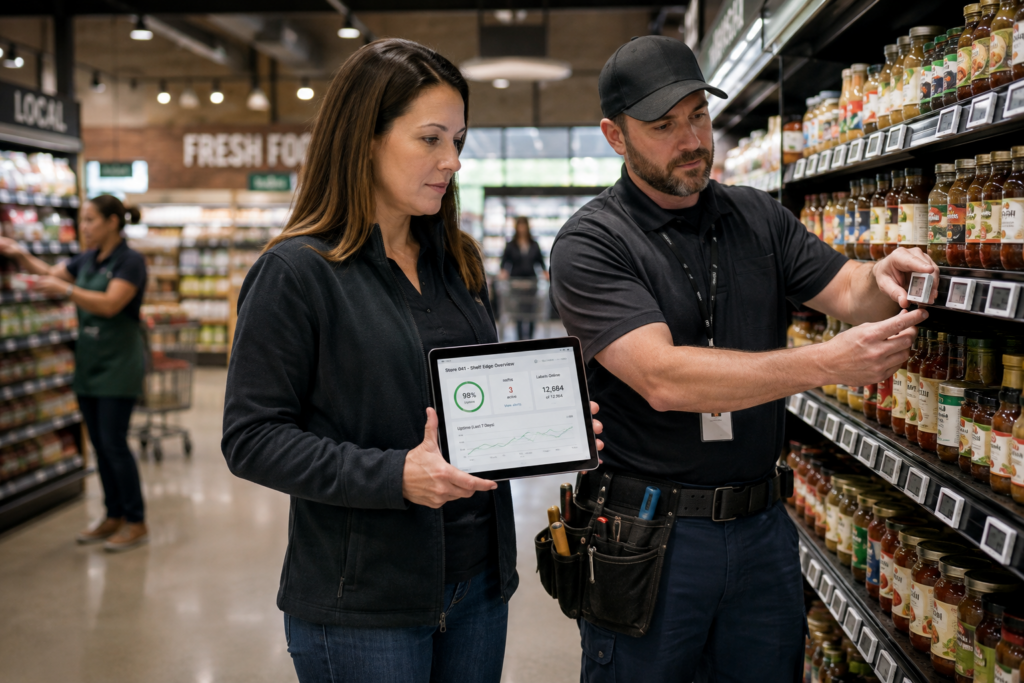
The physical layer: field service operations. When remote fixes hit their limit, someone has to be in the store. Rail failures, sensor drift, battery replacement, hands-on firmware issues: these are the tasks that determine whether an SLA holds in practice. A mid-market retailer usually cannot justify a dedicated shelf-edge tech team. A field service partner covering multiple retailers across a shared territory can provide that capacity. But only if the store footprint supports the economics and the relationship is contracted with clear response time requirements, not assumed.
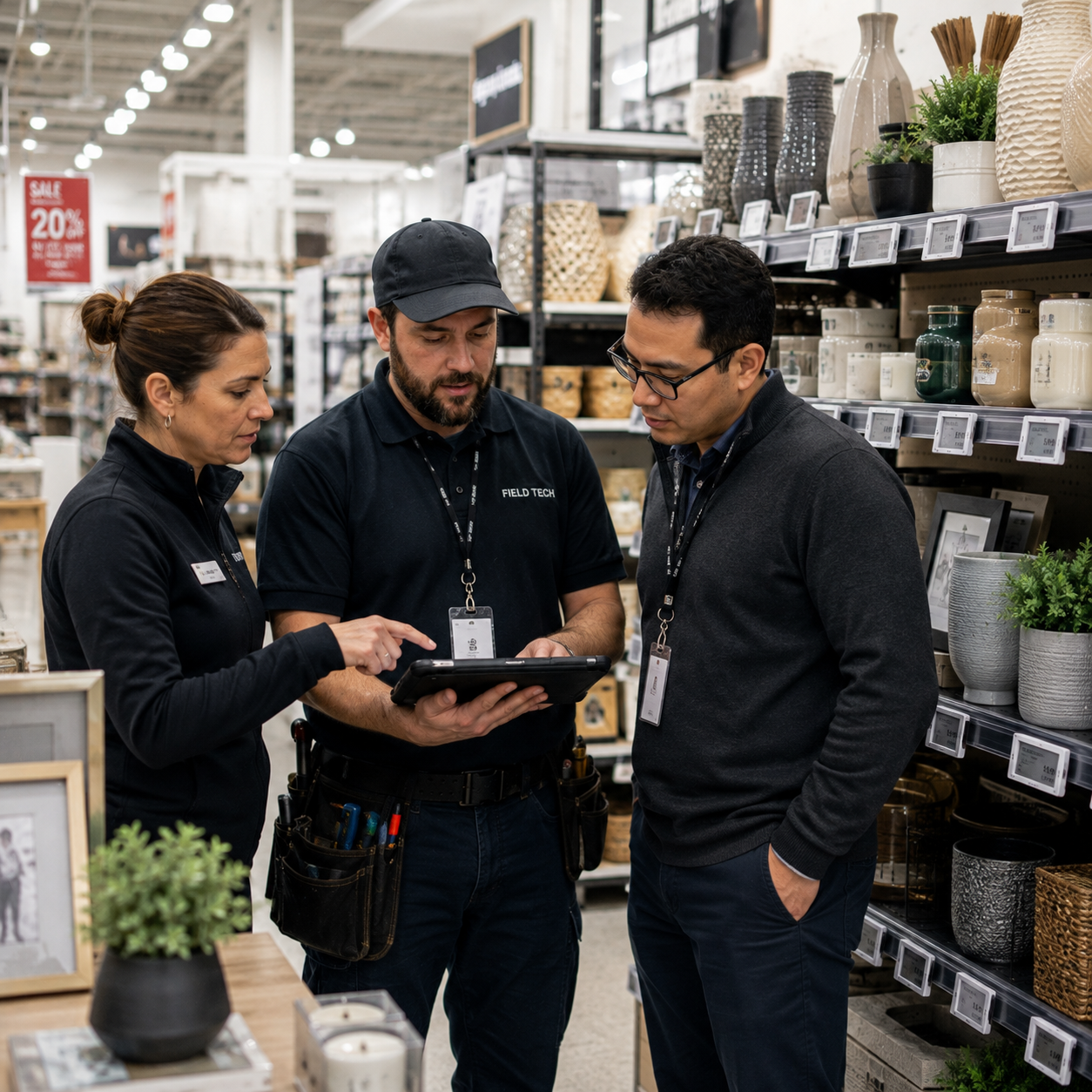
The integration layer: the organizational bridge. This is the most commonly missing layer. Someone has to manage the handoff between remote monitoring and physical execution. Someone has to own the escalation path when the MSP flags a problem that needs a field response. Someone has to make sure POS pricing, inventory data, and shelf labels are all telling the same story. This function has to be assigned explicitly, to a person or a partner, before the deployment goes live. It cannot be assumed.
The governance layer: the retailer. Accountability for connecting infrastructure performance to business outcomes stays inside the organization. Someone has to track whether the uptime the MSP reports is producing the margin improvement the business case projected. In mid-market organizations, this function often needs to sit higher than it would in a large enterprise, precisely because the distance between technology decisions and financial consequences is shorter.
 What a pilot actually needs to prove
The most common pilot failure is not technical. It is scope. A pilot that confirms the labels update and the vendor support team responds has tested the technology. It has not tested the operating model.
A pilot that is ready to scale has answered four questions. First: when the MSP flags a physical issue, does a field technician resolve it within the SLA window? Second: when pricing changes in the central system, how long before every label reflects it accurately? Third: at 90 days, is configuration drift being caught before it affects pricing or replenishment decisions? Fourth: what is the actual run cost per store per month, and does it match the business case?
Retailers who can answer those four questions clearly are ready to expand. Those who exit with a clean technology demo and an optimistic vendor relationship are not, even if everything looked good in the pilot stores.
The organizational readiness question
Mid-market retailers who succeed with shelf-edge infrastructure tend to share one characteristic: they assigned the integration layer before the pilot began. Either a strong internal champion owns that function, or a trusted external partner fills it. The role is explicit before go-live, not discovered afterward.
Assuming the MSP and the field partner will coordinate themselves does not work. Their contracts run to the retailer, not to each other. Without someone who has authority over both and owns the escalation path, the gap between the SLA on paper and the store experience in practice widens quietly. It usually shows up during a promotion or a seasonal peak, when every label in the store matters most.
The readiness assessment comes down to three questions. Who owns the integration layer? What authority do they have over both the MSP and the field partner? And how does that accountability connect to the financial reporting the business case requires?
Retailers who can answer those questions are ready to run a pilot that tests the operating model. Those who cannot should resolve the organizational question first. The technology will wait. The competitive pressure will not.
The next question this raises
Getting the operating model right closes the gap between mid-market operators and tier-one players. But it surfaces a deeper structural question. The traditional split between IT and store operations was designed for a different kind of store. An AI-native retail environment cannot be run by two teams that do not share accountability for the same outcomes. What that organizational model needs to look like for mid-market retailers is the subject of Part 5.
Conclusion
The technology works at mid-market scale. The economics support it. What the large-operator case studies do not show is how to build the operating model that makes it hold for a smaller organization.
The path runs through four layers: remote monitoring owned by an MSP or technology vendor, physical execution owned by a field service partner, an integration layer that connects the two, and governance that holds business outcome accountability inside the organization. Retailers with all four layers planned and staffed capture the projected ROI. Those who have two and assume the rest will work itself out usually find out otherwise at the worst possible time.
It has to look like something that works for the organization that is actually deploying it: resourced honestly, governed clearly, and built to run.
This analysis is part of a series on the operating model of the AI-native store, published by Worldlink.