

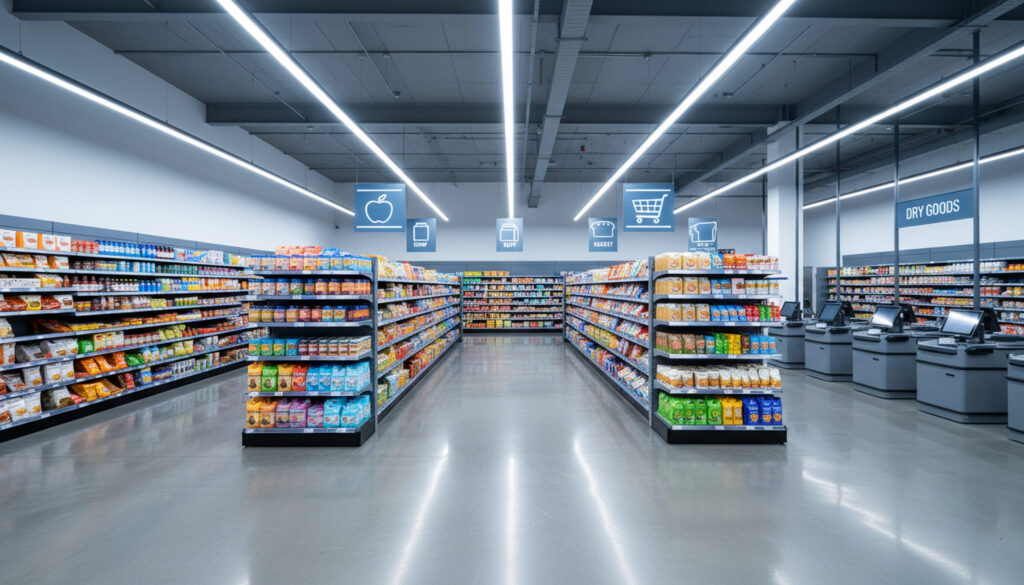
Why retail IT has moved from the back office to the sales floor, and what that means for how stores are built, run, and maintained.
Overview
For 20 years, retail IT lived in the back office, the network closet, and the checkout lane. In the AI-native store, the most important technology sits on the shelf itself — Bluetooth sensors, smart labels, edge computers, and context-aware displays. Together they form a shelf edge network: the most active part of a retailer’s infrastructure, and now the true network edge. This shift changes what store IT costs, how it fails, and who can run it.
Key takeaways
-
-
- The shelf is the new network edge. Tens of thousands of smart devices per store have moved compute and sensing out of the back office and onto the sales floor.
- The AI-native store is real, funded, and deploying now. 75% of retail executives plan major store transformation within two years. Walmart is converting 150 stores and remodeling 650 more to its “Stores of the Future” concept.
- Failure looks different now. Old store IT failed loudly — a system went down. New store IT fails quietly — a sensor keeps reporting, but the data is wrong.
- The number of smart devices per store has grown 100x or more. A store that had dozens of networked devices in 2015 can now have tens of thousands.
- Margin and labor gains depend on uptime. The projected 1.5–2 points of operating margin and 60–90 minutes saved per associate per shift only happen if the shelf-edge infrastructure actually works.
- This is a P&L issue, not just an IT issue. Retail media, real-time inventory, and customer experience all rest on whether the shelf can be trusted to report what is happening.
-
A shopper walking a grocery aisle in 2026 is surrounded by more active technology than the entire store had ten years ago. Most of it is on the shelf. Almost none of it is visible.
This is the most important change in physical retail this decade, and it has not been named clearly yet. For nearly 20 years, retail IT focused on three places: the back office, the network closet, and the checkout lane. The AI-native store flips that setup. Computing power, sensors, and intelligence move out to every shelf, every rail, every display. The shelf edge is the new network edge.
This is not a small change. It changes what store IT costs to run, how it fails, and who is qualified to maintain it. It raises four big questions that retail leaders now have to answer about cost, about trust in AI, about how to compete at scale, and about how store operations should be organized. This article covers the first question: what the shelf edge actually is, why it matters now, and why running it looks almost nothing like the retail IT that came before.
 What is the shelf edge network, and why does it matter now?
 What is the shelf edge network, and why does it matter now?
The shelf edge is the line where a retailer’s products meet its shoppers. It used to be a quiet place– a price tag, a label, a paper sign. In an AI-native store, it becomes the most wired-up surface in the building. That includes Bluetooth Low Energy (BLE) rails, electronic shelf labels, motion sensors, small edge computers, and digital displays that change based on what is happening nearby.
An AI-native store, as defined by Vusion and Qualcomm Technologies in their 2026 white paper, is a store that can sense what is going on, understand it right away, and act on it. It is built on three technologies that have come together: BLE as the signal layer, edge intelligence that puts computing power directly on the shelf, and on-device AI that responds in milliseconds without sending data to the cloud.
Three things explain why this matters now, not later.
Retailers are committing. 75% of executives plan major store transformation within two years, according to a Bain & Company and Vusion study. 44% expect 1.5 points of operating margin or more in return.
The bar has been set. Walmart has announced plans to build or convert more than 150 stores and remodel over 650 to its “Stores of the Future” concept across 47 states. These stores include AI-powered recommendations, real-time pricing, endless-aisle kiosks, and integrated pickup and delivery. Every other retailer now competes against that bar, whether they have responded to it or not.
The economics have flipped. Gartner expects global AI spending to top $2 trillion in 2026, up nearly 37% from 2025. Vusion reports that BLE-native infrastructure can cut battery-related total cost of ownership by up to 85% through shared energy across rails. These two facts change what is affordable.
The shelf edge matters now because the money, the architecture, and the competitive pressure have all arrived at the same time.
How is this different from the store IT of the last 20 years?
The shift is easiest to see in a side-by-side view.
| Traditional store IT (2005–2020) | The AI-native store (2025+) | |
| Where it lives | Back office, network closet, checkout lane | Every shelf, rail, sensor, display |
| Where computing happens | Central servers | Distributed edge devices |
| How signals move | Wired networks, batch updates | BLE, continuous, real-time |
| Smart devices per store | Dozens | Thousands to tens of thousands |
| How things fail | A system goes down | A capability degrades quietly |
| What IT does | Keep systems running | Keep the store sensing |
The jump in smart devices per store is the most overlooked number in retail IT. A large store in 2015 might have had a few dozen networked devices—registers, scanners, a few servers, some signage. An AI-native deployment can put tens of thousands of BLE devices in the same building. That is not a bigger version of the same problem. It is a different problem.
The change in how things fail matters just as much. Traditional store IT failed in obvious ways. A register stopped working. An alert went off. Someone fixed it. AI-native infrastructure often fails quietly. A sensor with bad calibration keeps sending data, but it’s wrong data. A shelf label with old firmware shows the wrong price while the dashboard stays green. This is called silent degradation, and detecting it is a skill most retail IT teams have not built yet.
What is actually running at the shelf edge?
The new shelf-edge stack has five layers. Each one creates work that did not exist before.
BLE-native rails and electronic shelf labels. Bluetooth Low Energy is now the universal signal layer in the store. It is open, global, and built into every smartphone. Price and content updates that used to take minutes now take seconds, and shared energy across rails means fewer batteries to manage.
Edge sensing and on-device AI. Smart processing happens right at the shelf instead of in the cloud. That means decisions can be made in milliseconds which is fast enough to react to a shopper standing in front of a display. Qualcomm Technologies’ chips are emerging as a key part of this layer.
Spatial and proximity sensors. These are the store’s nervous system. They track dwell time, product interaction, and shelf state as it happens, rather than guessing later from checkout data.
 Context-aware displays. In-aisle screens are no longer running on a loop. They change based on what is in stock, who is nearby, and what is selling. This is why retail media is, underneath, a hardware reliability story.
Computer vision at the shelf, where used. Cameras add another data layer for things like checking that products are stocked correctly and spotting theft patterns.
Together, these layers turn the store from a building with computers in it into a sensor network that runs all the time.
What does this change in daily operations?
The new architecture creates five operational realities that most retail IT teams are not yet set up to handle.
Managing the radio environment. Thousands of BLE devices in one store create a crowded airwave. That has to be planned, surveyed, and tuned. Skipping this step is a common reason early deployments underperform.
Battery and energy management. Even with shared energy cutting battery counts by up to 85%, the remaining batteries still need a real lifecycle plan, including when to replace, when to dispose, and how to forecast their depletion. This is now a recurring operational task, not a one-time setup.
Firmware and configuration drift. When you have 20,000 endpoints per store instead of 50, version control stops being a small task and becomes a discipline. A 1% drift across 20,000 devices is 200 silent problems.
Silent degradation as the main risk. Because shelf-edge devices keep sending data even when they are wrong, the question changes from “is it working?” to “is it telling the truth?” Catching bad data is a new skill that needs new tools and new training.
Hands-on work in the aisle. A broken rail in aisle 12 cannot be fixed by a help desk in another city. Someone has to walk to the shelf. Time-to-repair is measured in store hours and travel time, not network hops. In-store technical capacity becomes a frontline factor in whether the store performs.
Each of these is manageable on its own. Across hundreds of stores and a multi-year rollout, together they change what running a retail chain actually involves.
Why does this matter to retail leadership, not just IT?
The shelf edge looks like an IT issue. It behaves like a P&L issue.
Vusion’s analysis projects that large-scale AI-native programs can unlock 1.5 to 2 points of operating margin. In low-margin retail, even 0.1 points is a meaningful win. But those margin points are not won by buying the technology. They are won by keeping it running. Margin upside depends on uptime.
The same is true for labor. Early AI-native deployments show 60 to 90 minutes saved per associate per shift, mostly by replacing manual shelf checks with automated detection. That savings only happens if the shelves are actually sensing. If sensors are degraded, associates go back to manual routines and the labor savings disappear, often before anyone notices.
The competitive picture makes the stakes even clearer. Walmart’s Stores of the Future is not a pilot. It is a real, scaled deployment that sets a new shopper expectation across hundreds of stores and millions of weekly customers: accurate inventory, integrated retail media, smooth pickup, helpful in-aisle guidance. Every retailer competing for the same shopper now operates against that bar. The retailers who set the new standard will be the ones whose shelf-edge infrastructure works reliably enough to deliver on the experience. The retailers who deploy without operational discipline will find that AI-native infrastructure is unforgiving. It makes the gap between plan and execution bigger, not smaller.
The retail media opportunity has a similar pattern. The case for measurable, in-aisle ad attribution depends on whether the shelf can be trusted to report what really happened. The retail media revenue line in 2030 will be decided by the reliability of the sensors installed in 2026.
The shelf edge network is not an IT topic. It is a P&L topic that lives in IT.
 The four questions this raises
 The four questions this raises
If the shelf edge is the new network edge, retail leaders have to answer four questions that the old playbook does not cover:
-
-
- What does this actually cost to run? The economics of AI-native retail are an uptime story, and uptime is an operational discipline most transformation budgets have not yet priced in.
- How do we trust the AI built on top of this? AI agents and edge intelligence are only as honest as the sensors feeding them. Trustworthy AI is becoming a hardware reliability problem.
- How do mid-market and regional retailers compete with tier-one scale? Walmart’s Stores of the Future has set an industry bar. Closing the gap without Walmart’s balance sheet takes a different operating model.
- What does this mean for how store IT and field operations are organized? The old split between “IT” and “store operations” was built for an architecture that no longer exists.
-
Each of these is the subject of a coming article in this series.
Conclusion
The shelf edge network is the new network edge. Retail IT has not changed this much since the modern point-of-sale system was introduced. The center of gravity has moved from a small number of central systems to a large, distributed sensor network that lives where products and shoppers actually meet.
The retailers who see this clearly and build the operating discipline to match will define the next decade of physical retail. The ones who treat it as a tech upgrade rather than a real shift in architecture will spend that decade trying to close a widening gap.
The question is not whether the shift is real. The deployments are funded, the architecture is shipping, and the tier-one bar is already set. The question is execution.
This analysis is the first in our series on the operating model of the AI-native store.