


For retail IT leaders wrestling with the build vs buy depot services decision, the instinct to bring the function in-house is understandable — but the true costs are rarely what they appear. Most retailers who consider insourcing their depot services underestimate what it takes to run one. The instinct to bring the function in-house is understandable: more control, fewer outside dependencies, better use of existing distribution center (DC) space. But the gap between that instinct and a stable, fully operational depot is wider than most planning conversations acknowledge, and the costs hiding in that gap consistently outpace the projected savings.
Insourcing is the right answer for some retailers. The conditions that make it work, however, are more specific than they appear. For retailers who do not meet all of them, a managed service partnership delivers the control and accountability they are seeking without requiring them to operate a function they were never designed to run.
What Are Depot Services in Retail IT?
Retail IT depot services are centralized operations that manage the full lifecycle of store technology, including device staging, repair, inventory management, and systems integration.
Each function requires distinct skills and operates at a different pace:
- Device staging and configuration: Imaging laptops, setting up POS terminals, and preparing networking equipment before shipment to stores.
- Repair and refurbishment: Diagnosing failed devices, replacing components, and deciding whether equipment returns to service or is retired.
- Inventory management and logistics: Receiving inbound equipment, tracking asset status, managing spare pools, and fulfilling store replacement orders.
- Systems integration: Connecting depot activity to ticketing platforms, asset management tools, and procurement workflows.
Treating these four functions as a single thing is one of the most common mistakes in depot planning. It leads to staffing models that do not match operational needs and cost estimates that fall apart under scrutiny.
Why Do Retailers Consider Build vs Buy Depot Services?
Retailers consider insourcing depot services primarily to gain operational control, reduce third-party dependency, and lower costs. The most common motivations are:
Dependency risk. When depot services are outsourced, the retailer depends on a third party’s staffing, facility lease, technology systems, and business health. Any of those factors can introduce risk the retailer cannot manage from the outside.
Cost pressure. At sufficient volume and with the right staffing model, an internal depot can cost less than a third-party provider. That threshold is higher than most teams initially estimate, but the question is reasonable to ask.
Chain of custody. Every handoff between parties in the depot cycle is a potential source of delays and accountability gaps. The appeal of owning the entire chain is real.
DC space utilization. Retailers with underused distribution center space often see depot as a natural extension of what is already there.
These motivations are legitimate. The problem is that the evaluation rarely goes deep enough before the plan is set.
What Are the Hidden Costs of Insourcing Depot Services?
The hidden costs of insourcing depot services fall into a few categories: staffing difficulty, internal training burden, and physical build-out expenses. Each one is routinely underestimated.
Why Is Depot Staffing Harder Than It Looks?
Depot operations require people with specific, hands-on experience: technicians who can image and configure devices at volume, logistics clerks who can manage fast-moving inventory, and repair technicians with certifications that are not interchangeable. The technician who services payment terminals may not be qualified to repair mobile scanners.
Finding the right combination of skills is difficult under normal conditions. Under time pressure, it becomes the single biggest risk in the build plan. Experienced depot staff know their market value and decide where to land quickly. Plans that assume the right people will be available when the operation is ready to absorb them are plans that frequently get surprised.
 Who Owns Training When a Staffing Partner Provides the Labor?
 Who Owns Training When a Staffing Partner Provides the Labor?
If a staffing partner provides the labor, someone inside the retailer still has to own the process documentation, the onboarding program, and ongoing quality management. That responsibility does not come with the headcount.
This is one of the most consistently underestimated costs in insourcing plans. It is not just the time required to train new staff. It is the ongoing management overhead of running an operation the internal team was not originally built to run.
Why Do Depot Build-Out Costs Arrive Late and Exceed Estimates?
An effective depot requires more than open floor space. It needs a lab area with proper workspace and climate control for sensitive electronics, secure and auditable storage for payment devices and high-value inventory, and network infrastructure and physical security that meet compliance standards.
These costs are manageable, but they tend to surface late in the planning process when budgets are already set. The gap between estimated and actual build-out cost is one of the most reliable predictors of whether an insourcing project finishes on budget.
Transitioning from One Model to Another
There are costs that must be considered when you’re transitioning from one model to another. These costs are a little harder to quantify, but they exist.
Why Does Institutional Knowledge Disappear During Depot Transitions?
The individuals working in these roles accumulate operational knowledge that is hard to document and nearly impossible to replicate quickly. Which devices fail in which ways. Which stores have unusual configurations. Which informal processes have been quietly holding things together for years.
That knowledge lives in specific people. When those people are not part of the new structure, it disappears. A staffing model that brings in new people to run an undocumented operation is not a depot. It is a ramp-up period with no defined end.
Why Is the Transition Window the Riskiest Part of Any Depot Change?
Standing up a new operation model takes time. During that time, stores still need devices. The gap between when the old model ends and the new one reaches full speed is where service problems happen.
The risk compounds when the transition happens under pressure. An outgoing provider that is already struggling with staffing and morale is not a reliable partner for a smooth knowledge transfer. The more urgent the timeline, the more the retailer has to absorb on its own.
What Does the Staffing-Only Depot Model Actually Cost?
The staffing-only depot model, where the retailer uses its own DC space and a staffing partner provides the labor, transfers the work but keeps all management risk with the retailer.
The retailer absorbs every management decision: documentation, onboarding, quality oversight, scaling, and turnover. If the staffing partner loses a key resource, the retailer pays the retraining cost. If something goes wrong, the retailer owns the outcome regardless of where the failure started.
The cost model also surprises. Staffing a full depot function with technicians, logistics staff, and a program manager adds up quickly when fully loaded with benefits, management overhead, and turnover cost. Retailers who compare that total to what they were paying a managed provider often find the gap is smaller than expected, and sometimes it points in the other direction.
When Does Insourcing Depot Services Actually Make Sense?
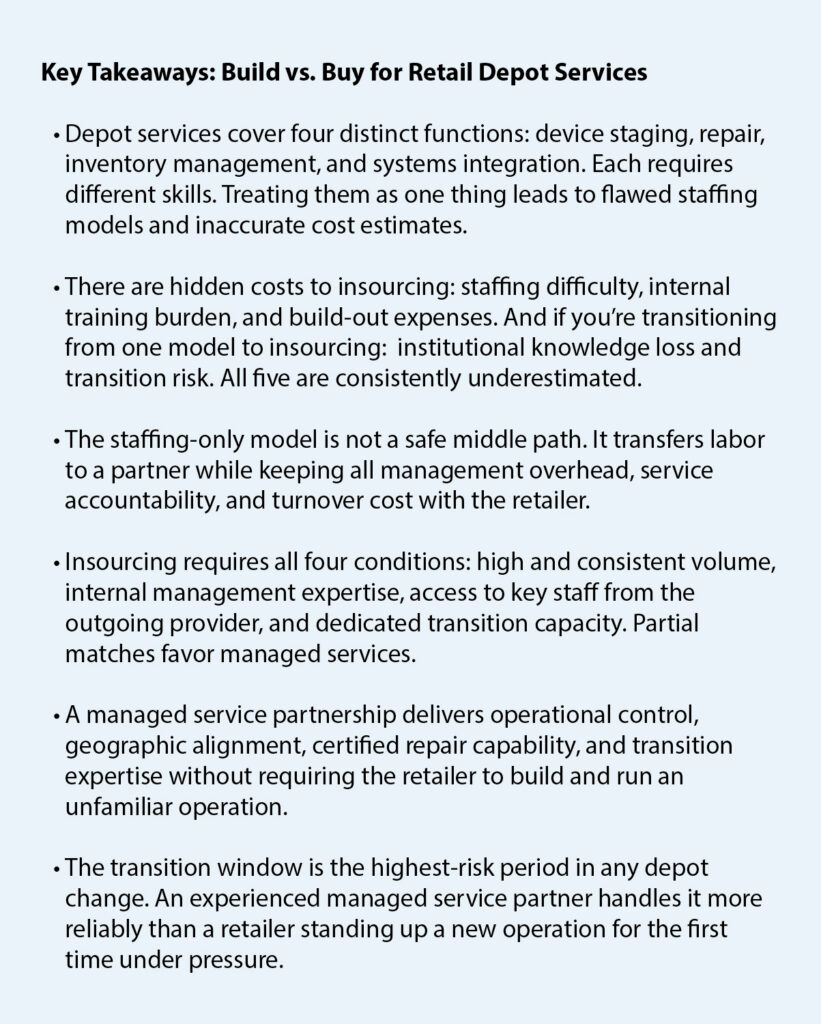 Insourcing depot services makes sense only when a retailer meets all four of the following conditions: very high and consistent device volume, internal depot management expertise, access to key staff from the outgoing provider, and dedicated capacity to manage the transition.
Very high and consistent volume. A dedicated depot team is a fixed cost. The economics only work when device volume is high enough and stable enough to keep that team fully productive year-round. Retailers with seasonal variation or project-driven demand spikes are not good candidates for a fully internal model.
Internal management expertise. Bringing in a staffing partner for the labor is not the same as having management that understands how depot operations run. Someone inside the organization needs to have run this kind of operation before, not learn alongside the new staff.
Access to key people from the outgoing operation. The single most important factor in a successful insourcing transition is retaining people who carry institutional knowledge of the current environment. Without them, the timeline to stable operations extends significantly.
Real capacity to manage the transition. A depot transition runs in parallel with the ongoing business and requires dedicated internal resources to manage. Organizations already stretched thin are not in a position to absorb that workload without other areas suffering.
Most retailers evaluating this question honestly will find they meet some of these conditions but not all of them. That partial match is where managed service partnerships consistently outperform the self-build model.
What Is the Alternative to Building an In-House Depot?
The alternative to building an in-house depot is a managed service depot partnership that gives the retailer operational control, geographic alignment, and a single point of accountability without the burden of running a function it was not designed for.
A well-structured managed services arrangement is different from traditional outsourcing. The retailer defines the scope, sets service standards, owns the inventory data, and maintains visibility into day-to-day activity. The partner provides the facility, certified staff, repair relationships, and operational management.
This model also handles the transition problem more reliably. An experienced managed service partner has stood up depot operations before. They know how to capture institutional knowledge from an outgoing provider, how to staff and train a new team, and how to reach stable operations without a prolonged service degradation in between.
Retailers who navigate depot transitions most successfully are generally not the ones who moved everything in-house. They are the ones who found a partner who could take real ownership of the function while keeping the retailer in control of what mattered most.
Wolrdlink does offer depot services from some clients. If you’d like to discuss using that service, contact us for a consultation.