


Every margin point and labor-hour saving promised by the AI-native store depends on the infrastructure actually working. Here is how the math is changing.
Overview
The AI-native store promises real numbers: up to 2 points of operating margin, 60 to 90 minutes saved per associate per shift, a new high-margin retail media revenue line. Those numbers are real. They are also conditional. In a shelf-edge network of tens of thousands of devices per store, every projected benefit depends on whether the infrastructure stays up. Uptime is no longer just an IT metric. It is the ROI.
Key takeaways
-
-
- Uptime drives every benefit in the business case. Margin, labor savings, and retail media revenue all depend on a working shelf edge network.
- Most business cases price the build, not the run. Capital cost is modeled in detail. Operating cost is often a footnote.
- Failure is now quiet, not loud. Sensors keep reporting when they drift. Dashboards stay green while data goes wrong.
- Labor savings can reverse without anyone noticing. When sensors degrade, associates go back to manual checks — and the 60–90 minutes saved per shift quietly disappear.
- Operating cost often equals or exceeds capital cost over five years. This is true for most distributed infrastructure. The shelf edge network is no exception.
- Retail IT is the team best positioned to make this argument. The numbers finance cares about now depend on the disciplines IT has been advocating for all along.
-
A business case lands on a CFO’s desk. It projects 1.5 to 2 points of operating margin from an AI-native store rollout. The capex is detailed. The vendor list is complete. The timeline looks clean.
What the model usually does not show is the work required to actually capture those margin points after the rollout ends. The sensors have to keep sensing. The shelf labels have to keep updating. The edge compute has to keep running. The RF environment has to stay tuned. None of that is free, and most business cases price it lightly or not at all.
This article covers the question Part 1 left open: what does an AI-native store actually cost to run, and why is uptime the variable that decides whether the projected ROI shows up? The short answer: in a shelf-edge network with tens of thousands of endpoints per store, the gap between deploying the technology and capturing its value is bigger than the gap between not having it and having it. That gap is uptime.
What is the real cost of running an AI-native store?
Most transformation business cases price four things well: hardware, installation, integration, and software licensing. These are capital costs. They are easy to model because the vendors quote them.
What gets priced lightly, or skipped, is the operating cost of keeping the system running after go-live. For a shelf edge network, that includes four things:
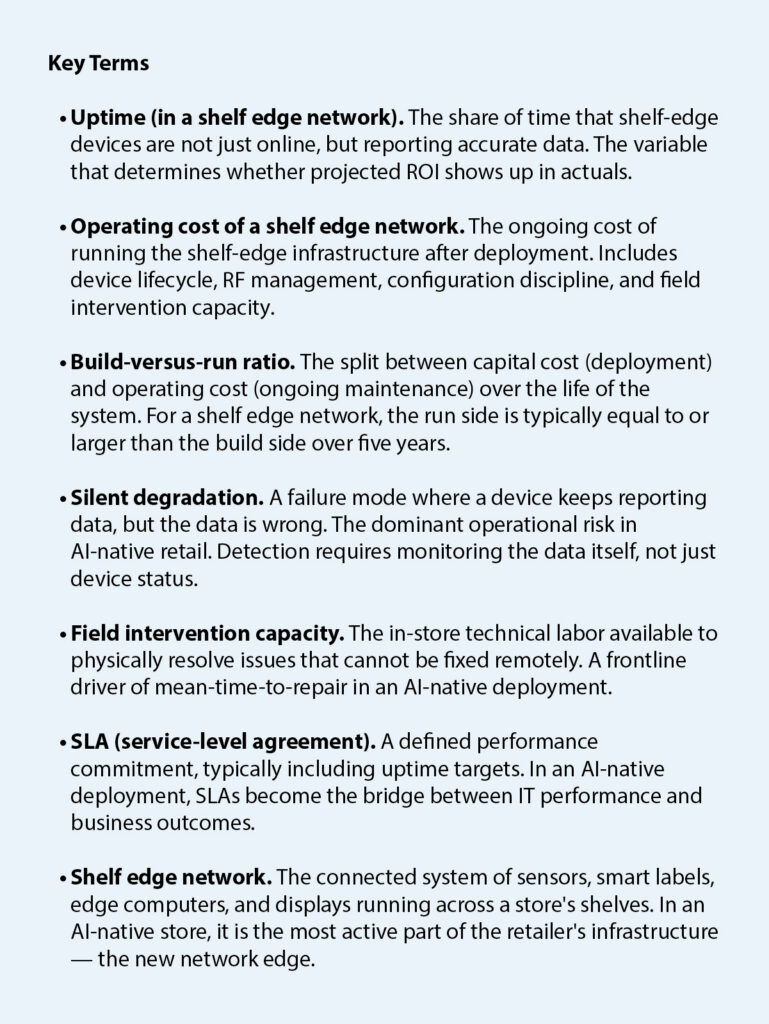
Device lifecycle. Batteries, replacements, end-of-life refreshes. Even with shared energy cutting battery counts by up to 85%, the remaining batteries still need to be tracked, replaced on schedule, and disposed of properly.
Signal environment management. Thousands of BLE devices in one site create a crowded RF environment. It has to be surveyed, tuned, and re-checked when the store layout changes. RF is not a set-it-and-forget-it install.
Configuration and firmware control. When you have 20,000 endpoints per store, version control is no longer a small task. A 1% drift across 20,000 devices is 200 silent problems.
In-aisle field work. When a rail fails in aisle 12, the help desk cannot fix it from a desk in another city. Someone has to walk to the shelf. That field capacity is now part of the operating cost, whether it sits in the IT budget or the store ops budget.
For most distributed infrastructure, the five-year operating cost equals or exceeds the capital cost. The shelf edge network is not an exception. A business case that prices the build but underprices the run will overstate the ROI, and sometimes by a lot.
Why does uptime drive AI-native store ROI specifically?
Every major benefit in the AI-native business case has the same dependency: a working shelf edge network. When the shelf edge network is degraded, the benefit is degraded with it. The mechanism is worth walking through, because this is where IT can make the clearest case to finance.
 Labor savings reverse silently when sensors degrade. The 60 to 90 minutes saved per associate per shift come from automated detection. Sensors flag the stockout. The system creates the task. The associate restocks the shelf. No manual walk-through required.
But when sensors drift, the automated flagging stops working. Associates do not get notified. They go back to walking the aisle to check for themselves. The same manual routine the AI-native store was supposed to eliminate. The labor savings disappear, but the dashboard does not flag it, because the sensor is still reporting. It is just reporting wrong. This is the silent degradation, and it is the most common way labor ROI quietly leaks out of an AI-native deployment.
Margin upside depends on shelf truth. The 1.5 to 2 margin points come from a stack of small wins: accurate pricing across the store, dynamic promotions tied to live demand, fewer stockouts, less shrink, better retail media attribution. Every one of those wins depends on the shelf edge network reporting accurately.
If even 5% of sensors are degraded across a 1,000-store chain, the margin model breaks before anyone sees a red light. Wrong prices ship. Promotions misfire. Stockouts get reported as in-stock. None of it triggers an alert, because each device is still online.
Retail media revenue requires verifiable impressions. The retail media case requires closed-loop, deterministic attribution at the shelf. Brands pay for the ad. The shelf-edge sensors verify the shopper saw it. The POS confirms the lift. The whole revenue line works because the data can be trusted. Retail media and edge AI infrastructure is all linked together and driving the new economics of space.
If the sensors degrade, brands stop trusting the impression counts. Retailers cannot defend pricing. The revenue line shrinks faster than it grew. Of all three loss vectors, this one is the most fragile, because brand trust is harder to rebuild than internal labor metrics.
In an AI-native store, if maintenance slips, the numbers slip with it.
What does maintaining a shelf edge network actually involve?
Most IT teams reading this already know what the work looks like. It is worth naming it cleanly anyway, both for finance readers and because the scale changes the nature of each task.
RF environment management. Survey, tune, re-survey when layouts change. Interference monitoring on an ongoing basis, not just at install. At scale, RF drift is one of the top causes of underperforming pilots.
Firmware and configuration discipline. Tracking versions across tens of thousands of endpoints per store, pushing updates in waves, rolling back when something goes wrong. The discipline itself is familiar. The endpoint count is not.
Battery management. Smart shelf labels run on batteries. Even with new designs that share power across rails and cut the total count, a single store can still have thousands of batteries to track, replace, and dispose of. It is a real, recurring operational task, not a one-time setup.
Drift and calibration detection. This is the new one, and the one most teams are still building muscle for. Monitoring has to move past “is it online” to “is it telling the truth.” That means telemetry on the data itself, including calibration checks, anomaly detection, drift alerts. Without it, silent degradation goes unseen until it shows up in P&L.
Field intervention capacity. Hands available to walk to the shelf when remote remediation fails. Mean-time-to-repair is now measured in store-hours and travel time, not network hops. In-store technical capacity becomes a frontline factor in whether the site performs.
These disciplines are not new in spirit. Retail IT has been carrying versions of them for years. What is new is the scale, the failure mode, and the financial stakes. A 1% problem at 50 endpoints is annoying. A 1% problem at 20,000 endpoints, across 500 stores, is a margin event.
How is the math changing for the people doing the modeling?
For finance teams modeling these deployments, three things are changing.
The build-versus-run ratio is shifting. Older retail IT projects, a POS refresh, a network upgrade, were heavy on capex and lighter on opex. The shelf edge network is the opposite. The devices are cheaper per unit, but there are far more of them, and they live in a harsher environment than a server room. Maintaining that footprint is the larger and longer cost. Business cases that use older ratios will get the number wrong.
Uptime needs to be a named line, not buried in overhead. Most maintenance budgets are absorbed into general opex. In an AI-native deployment, that hides the variable that drives the entire ROI. A more honest model names uptime as a line item, ties it to an SLA, and ties the SLA back to the margin and labor projections in the original case. If the SLA slips, the projections slip with it. Making that connection visible changes how the project gets governed.
Field labor belongs in the IT budget, not the store ops budget. Historically, in-store technical work has lived in store operations. For example, a manager calls the help desk, a tech eventually shows up, the cost gets absorbed locally. That model does not survive a 20,000-endpoint deployment. Field intervention is now an IT function with a service level attached to it. Trying to keep it in store ops means the team that owns the SLA does not own the resources to meet it. That mismatch is one of the most common reasons rollouts underperform their business case.
The net effect of these three shifts: the people modeling the ROI need a different picture of what they are modeling. Capital cost is the small part. Run cost, uptime, and field capacity are the variables that decide whether the projections hold.
Why retail IT is the right team to make this argument?
For a long time, retail IT has been the team absorbing the gap between transformation ambition and operational reality. The dashboards that look green while the shelf data drifts. The rollout that goes live on schedule but quietly underperforms. The labor savings number that never quite shows up in the actuals. IT has seen this pattern before, in earlier waves of in-store tech.
 The shift to AI-native infrastructure changes one thing about that pattern: it makes it financially undeniable. The gap that used to surface as a quiet IT problem now surfaces as missed margin guidance. The drift that used to be hard to explain to anyone outside IT now connects directly to numbers the CFO and CEO track every quarter.
That gives retail IT a leverage point that did not exist before. The maintenance disciplines, the SLA structures, the field capacity arguments–all the things IT has been advocating for and getting told to absorb, are now directly tied to the metrics finance cares about most. The conversation is no longer “IT wants more budget.” It is “IT is the team that defends the margin we just told the board to expect.”
The case for uptime is no longer a technical case. It is a business case retail IT is uniquely positioned to make.
The next question this raises
Uptime keeps the existing business case honest. But there is a second risk on the horizon, built on top of the same shelf edge network: the AI making decisions from the data those sensors produce. Even when the sensors are working, can the AI built on top of them be trusted? That is the subject of Part 3.
Conclusion
AI-native store ROI is real. The margin upside is real. The operational tax is also real. Uptime is the variable that decides which one a retailer experiences.
For finance, that means the ROI lives or dies in the run phase, not the build phase. For retail IT, it means the disciplines they have been carrying for years are now the ones the rest of the business depends on. For the deployment partners working alongside the field techs, the rollout teams, and the maintenance contracts, it means the work has never mattered more.
In an AI-native store, every margin point lives or dies at the shelf edge. Uptime is the ROI.
This analysis is the second in a series on the operating model of the AI-native store, published by Worldlink.