


In the AI-native store, autonomous agents are making pricing, reordering, and task decisions in real time. Whether those decisions can be trusted depends on something more physical than most AI conversations acknowledge.
Summary
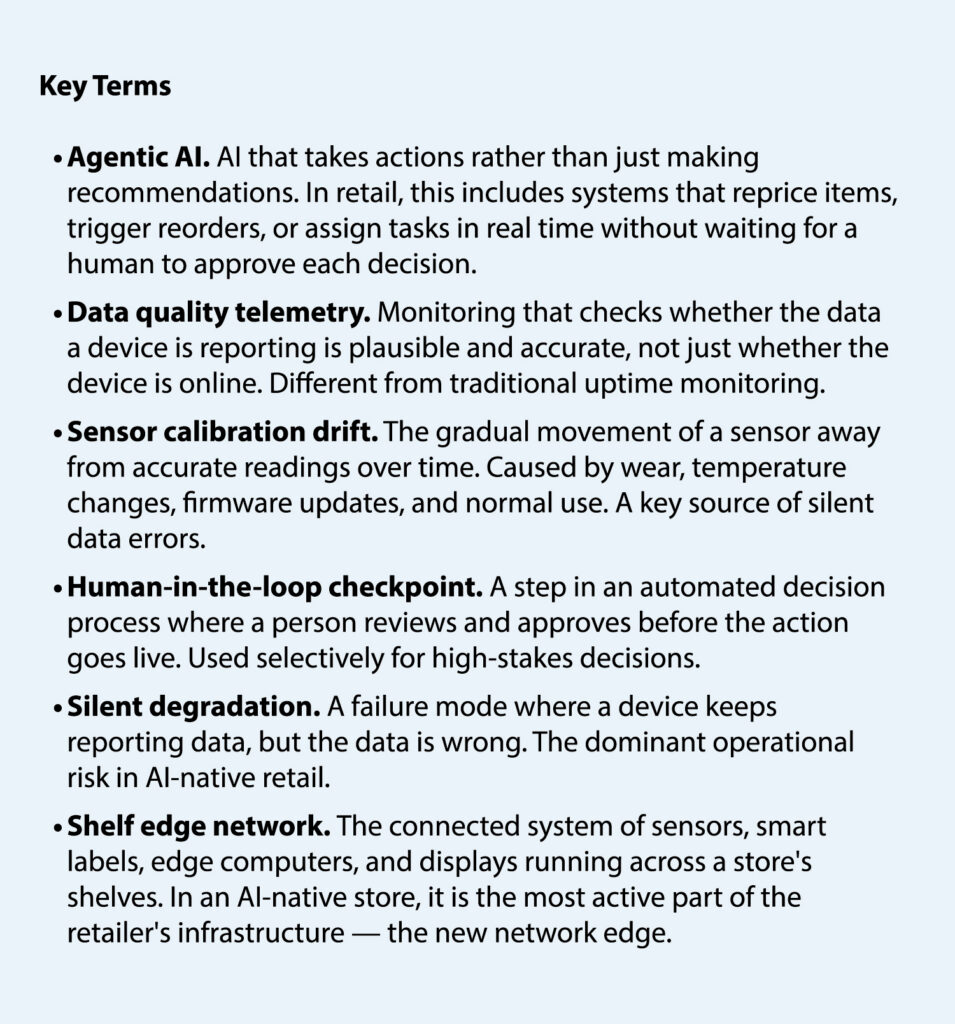
A new kind of AI is showing up in AI-native stores. It doesn’t just recommend actions. It takes them. It changes prices, triggers reorders, and assigns tasks without a human clicking approve on each decision. This is called agentic AI, and it is arriving faster than most retailers expected. Every decision these agents make is based on data coming from the shelf edge network. If that data is wrong, the AI does not fail loudly. It acts wrongly, at scale, before anyone notices. Trustworthy AI in retail is not just a model problem. It is a data quality problem, and it starts at the shelf.
Key takeaways
-
-
- Agentic AI is already in stores. Autonomous agents are repricing items, triggering reorders, and assigning tasks in real time.
- These agents make decisions based on shelf sensor data. The trustworthiness of the AI depends on the trustworthiness of that data.
- Bad data does not stop an agent. It just makes the agent wrong. Traditional bad data produced bad reports. Agentic AI turns bad data into bad actions.
- The failure is upstream of the model. Most AI trust conversations focus on the model itself. In retail, the more common failure is a drifted sensor feeding a working model.
- Trustworthy AI needs new kinds of monitoring. Not just “is the device online” but “is the data plausible.”
- Retail IT owns the layer that makes AI honest. Model builders and vendors build the AI. Retail IT keeps the data underneath it trustworthy.
-
At 2:14 on a Tuesday afternoon, an AI agent inside a national retailer’s pricing system quietly changes the shelf price on 400 items across 200 stores. The changes are small, a few cents up here, a few cents down there, driven by real-time signals about demand, competitor moves, and current inventory. Nobody at the retailer approves each change. The system just does it. This is not a future scenario. This is 2026.
The efficiency case for this kind of automation is obvious. The trust question is harder. Every one of those 400 price changes is based on data flowing from the shelf edge network where sensors are reporting stock levels, movement, and shelf state. If that data is right, the AI works as designed. If any of it is wrong, the AI still works. It just works wrongly, quietly, and at scale.
This article covers a question that most AI conversations skip: in an AI-native store, what does it actually take to make the AI trustworthy? The short answer is that the trust problem is not where most people think it is. It is not primarily a model problem. It is a data quality problem, and it lives at the shelf.
What is agentic AI, and where is it showing up in retail?
Agentic AI is AI that takes actions, not just recommendations. Earlier AI in retail was mostly analytical. It forecast demand, segmented customers, suggested promotions, and left the actual decisions to humans. Agentic AI closes that loop. It does the thing.
In AI-native stores, three types of agents are the most common right now.
Dynamic pricing agents adjust shelf prices in real time based on current demand, competitor moves, and inventory levels. Prices that used to change weekly can now change hourly, without a person reviewing each one.
Replenishment agents trigger restocks and vendor orders based on live shelf state, not the batch reports that used to run overnight. When a shelf is low, the agent notices, and the order goes out.
Task orchestration agents create and assign work to associates based on real-time store conditions. A stockout on aisle 12, a spill on aisle 4, a queue building at the pickup counter, the agent sees it, prioritizes it, and routes it to the right person.
According to the National Retail Federation’s 2026 trends analysis, roughly 40% of enterprise applications will ship with task-specific AI agents by the end of the year, and the risk profile of these systems climbs sharply as they take on autonomous decisions across integrated systems. In retail, the integration point for most of those decisions is the shelf edge network. That is where the data comes from. That is where the trust question starts.
 Why is AI trustworthiness a data problem, not just a model problem?
 Why is AI trustworthiness a data problem, not just a model problem?
The public conversation about trustworthy AI focuses on the model. Is it biased? Does it hallucinate? Are the guardrails strong enough? Those are real questions. In a retail context, though, the more common failure looks different and it is worth walking through step by step, because it explains a lot about what can go wrong.
Picture a shelf sensor that has drifted slightly out of calibration. It is still online. Its dashboard is still green. But its readings are off. It is reporting shelf stock as lower than it actually is.
A replenishment agent reads that data as truth. It sees a stockout that isn’t real. It triggers an emergency reorder. The order goes through, the vendor ships extra inventory, the truck arrives, and the store now has too much of a product it did not need more of. Nobody flags a problem, because from the system’s point of view, everything worked exactly as designed.
Now scale that up. One drifted sensor is a rounding error. A hundred drifted sensors across 500 stores is a supply chain event. The AI did not fail. It did exactly what it was designed to do. But the input was wrong, so the output was wrong.
The old version of this problem was familiar: bad data leads to bad reports. The new version is different. Bad data leads to bad actions–automatic ones, at scale, before a human sees them. It’s not a fringe concern — MIT Sloan research found that 82% of executives name organizational data quality as the greatest barrier to their GenAI goals, and in retail, that problem starts at the shelf
This is why trustworthy AI in retail cannot be solved only at the model layer. If the sensor data feeding the model is wrong, the model will make wrong decisions with high confidence, and the store will feel the consequences before anyone realizes the model was working from bad input.
What does trustworthy AI actually require at the shelf edge?
If the trust problem is upstream of the model, then making AI trustworthy means doing three things at the shelf edge that most retailers have not yet built as regular practices.
Ongoing sensor calibration. Sensors drift over time. Temperature changes, physical bumps, firmware updates, and normal wear all move a sensor away from accurate readings. Traditional retail IT treats calibration as an install-time task. In an AI-native environment, it becomes a recurring one with scheduled checks, drift detection, and clear rules for what to do when a sensor is out of tolerance.
Monitoring the data, not just the device. Most current monitoring answers one question: is the device online? Trustworthy AI needs monitoring that answers a second one: is the data believable? A sensor that reports a shelf going from 90% full to 10% full in 30 seconds is technically online, but the reading is almost certainly wrong. Catching that requires new tools and new rules and this is a category of monitoring most teams are still building.
Human checkpoints where the stakes are high. Not every agent decision needs human review. Most of the point of agentic AI is speed. But some decisions including large price changes, unusually big reorders, promotions above a certain threshold, are worth routing through a person before they go live. Deciding where those gates belong is a conversation between IT, finance, merchandising, and store operations. It is a governance question, not just a technical one.
None of this replaces the work of the model builders or the AI vendors. Their work makes the agents smart. This work makes the data those agents rely on trustworthy. Both layers matter, and neither works without the other.
How does this change what retail IT is accountable for?
Retail IT used to be accountable for keeping systems running. That job is not going away, but it is expanding. In an AI-native store, IT is also becoming accountable for whether the data those systems produce is trustworthy enough for autonomous agents to act on.
That is a bigger role than it might sound. Each layer of the AI-native store adds a new accountability. The shelf edge network has to be built right (Part 1). The infrastructure has to stay up (Part 2). And now, the data flowing to AI decision layers has to be trustworthy (this piece). Each of those layers connects directly to business outcomes including margin, customer experience, brand trust. Each one is a place where retail IT can either quietly absorb the problem, or get properly resourced to solve it.
The good news for retail IT: this changes their role in the AI conversation. AI in retail is often framed as a data science or vendor topic, with IT brought in for implementation. But the trustworthiness of the whole system, the model, the agents, and the data, depends on the infrastructure and monitoring that retail IT owns. That makes IT a required voice in AI governance, not an afterthought.
The case for AI trust is not a model debate. It is an infrastructure conversation, and retail IT is at the center of it.
The next question this raises
An AI-native store that stays up and stays honest is a real competitive advantage. The problem is that building one at tier-one scale, like the Walmart Stores of the Future benchmark that Part 1 introduced, requires either tier-one resources or a very different operating model. For most retailers, the second path is the only one available. That is the subject of Part 4.
Conclusion
The AI conversation in retail is dominated by what the models can do. The more important question, increasingly, is what the models are being told. In an AI-native store, that answer comes from the shelf edge network. Its trustworthiness decides whether the AI built on top of it is a competitive advantage or a quiet risk.
Model builders and AI vendors build the intelligence. Retail IT, alongside its deployment partners, makes the data underneath it trustworthy. Both jobs matter. Neither works alone.
An AI agent is only as honest as the shelf beneath it. Making that shelf tell the truth is the work.
This analysis is the third in a series on the operating model of the AI-native store, published by Worldlink, an on-site IT services firm serving chain retailers across North America.